

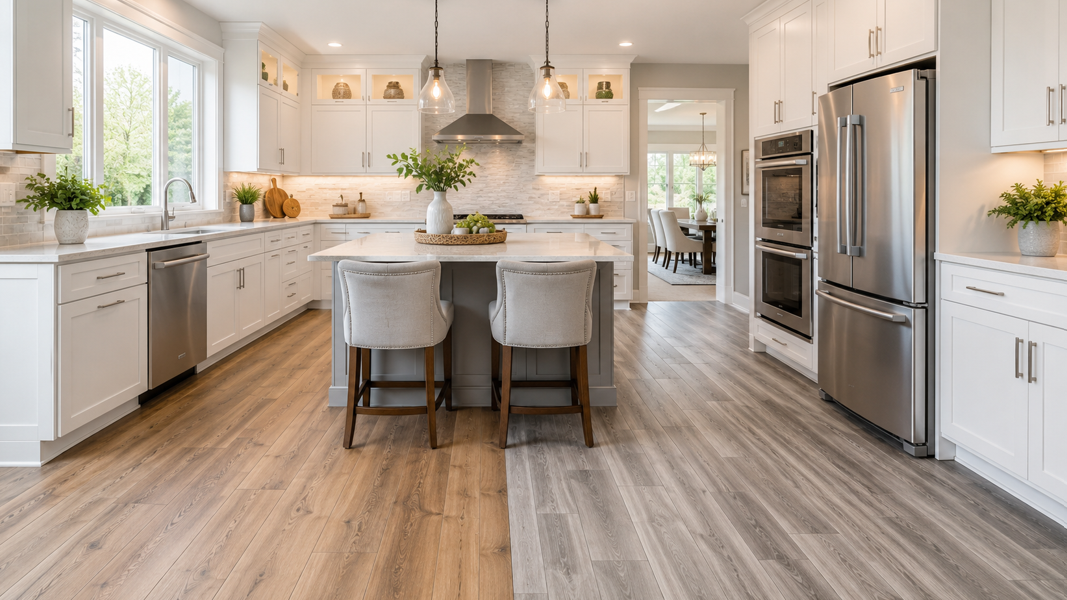
The kitchen asks more of a floor than almost any other room. It deals with dropped utensils, chair movement, muddy shoes, cooking spills, pet traffic, grocery runs, and plenty of cleaning. In a Northville home, it may also sit close to an entry where Michigan snow and slush get tracked inside for months at a time.
That is why homeowners often narrow their kitchen flooring search to two practical choices: laminate and vinyl. Both can deliver convincing wood or stone looks, both come in styles that suit updated and traditional interiors, and both can be easier to maintain than many natural materials. Urban Floors currently carries laminate as well as vinyl and luxury vinyl among its flooring categories.
So which one is better for a kitchen? Vinyl often has the edge when moisture exposure is the top concern, while laminate can be especially appealing when homeowners want a firm, realistic wood look with strong everyday wear performance. The better choice depends on the exact product, the way your kitchen is used, and the features you value most.
Northville homeowners can compare both options with guidance from Urban Floors, which offers in-store shopping, online visualizing tools, samples, and assistance from flooring specialists.
Start With the Biggest Difference: What Are Laminate and Vinyl Made Of?
Laminate and vinyl can look surprisingly similar once installed, especially when both are designed to mimic hardwood. Under the surface, however, they are different products.
Laminate Uses a Wood-Based Core
Laminate is a layered flooring product. Urban Floors describes it as a fused material that typically includes a backing or underlayment, a core made from materials such as high-density or medium-density fiberboard, a printed image layer, and a protective wear layer on top. The image layer gives laminate its wood, stone, or tile appearance.
That construction is one reason quality laminate can feel firm underfoot and produce detailed wood visuals. Modern embossing and imaging can recreate grain, knots, and other characteristics that give the surface more depth than many homeowners expect.
Vinyl Is a Resilient Flooring Material
Vinyl belongs to the resilient flooring category. Modern products are available in several forms, including planks and tiles designed to recreate wood or stone. Rigid-core luxury vinyl may use WPC or SPC constructions, while other vinyl products use different flexible or layered structures.
The Resilient Floor Covering Institute identifies resilient flooring as a practical fit for kitchens and other residential spaces where cleanability, style, and moisture performance matter. It also notes that water-resistant or waterproof performance depends on construction.
That last point matters. “Vinyl” does not describe one identical floor, just as “laminate” does not. Product specifications matter more than assumptions about an entire category.
Moisture Resistance: Which Makes More Sense Around Sinks and Dishwashers?
For many kitchen remodels, moisture becomes the deciding factor.
A dishwasher can leak. A pet bowl gets knocked over. Ice falls from the refrigerator dispenser. A pan splashes at the sink. During a Northville winter, wet footwear can add another source of moisture if the kitchen is near a mudroom or back entrance.
Vinyl Usually Offers the Stronger Moisture Story
Many modern vinyl floors are designed for moisture-prone residential areas. RFCI specifically identifies resilient flooring as a practical fit for kitchens and notes that some constructions provide waterproof performance.
This can make vinyl attractive in busy kitchens where spills are frequent. Still, read the warranty and care instructions for the exact product. Waterproof flooring does not mean the entire room or subfloor becomes protected from flooding. Water may still reach walls, cabinets, transitions, or the subfloor depending on the situation.
Laminate Requires More Product-Specific Attention
Traditional laminate has a wood-based core, so excessive moisture has historically been a concern. Today, there are laminate products with improved water resistance, and some are specifically certified or marketed for stronger moisture performance.
The North American Laminate Flooring Association says laminate can be used in kitchens, but areas with excessive moisture require a product specifically designated for that level of exposure. NALFA also maintains optional water-resistance testing within its certification standards.
For a Northville kitchen, the useful question is not simply, “Can laminate go in a kitchen?” It is, “What moisture rating and warranty does this particular laminate provide?”
Everyday Durability: Scratches, Scuffs, and Family Traffic
Kitchen flooring takes concentrated wear. The path between the refrigerator, sink, island, and range can see constant traffic.
Laminate Has a Protective Wear Surface
One of laminate’s strengths is its protective top layer. Urban Floors describes laminate as having a wear sheet designed to protect the decorative surface from scratches and scuffs.
That can make laminate appealing for households with children, pets, dining chairs, and frequent kitchen traffic. Compare the manufacturer’s wear rating, warranty, finish, and care guidance for the exact product you are considering.
Vinyl Handles Busy Routines Too
Vinyl is also widely chosen for active homes because it combines resilience with straightforward cleaning. Some rigid-core products are developed for high-traffic residential use, but performance varies by wear layer, construction, finish, and manufacturer.
No flooring surface is completely immune to wear. Felt protectors, regular grit removal, trimmed pet nails, prompt spill cleanup, and manufacturer-approved cleaners can help either floor maintain its appearance.
Which One Looks More Like Real Hardwood?
This comparison is more subjective.
Both laminate and vinyl have improved dramatically in visual realism. Digital printing, surface texturing, bevel details, and larger plank formats can make either material a convincing alternative to natural wood.
Laminate Can Deliver Excellent Wood Detail
Because laminate uses a printed design layer over a rigid wood-based core, manufacturers can create detailed grain, knots, color variation, and plank visuals. Urban Floors highlights modern laminate’s deeper embossing and improved imagery as reasons today’s products look more natural than earlier generations.
Homeowners comparing laminate flooring can look at several boards together rather than judging a style from one sample. That makes it easier to assess pattern repetition, color variation, bevels, texture, and how the floor will read across a larger Northville kitchen.
Vinyl Offers Broad Design Flexibility
Vinyl is equally versatile from a design standpoint. Wood looks dominate many plank collections, while tile and stone visuals offer another direction for kitchen design. Some luxury vinyl products also align surface texture with the printed grain to create a more convincing wood effect.
Instead of asking which category looks “more realistic” in general, compare the actual products beside your kitchen finishes. A warm oak look may suit cream cabinets and natural stone, while a cooler neutral plank can work beautifully with white cabinetry and darker accents.
Comfort, Sound, and the Feel Underfoot
Kitchens involve a lot of standing, so the way a floor feels can matter almost as much as how it looks.
Vinyl Can Feel More Forgiving
Some vinyl constructions feel slightly softer or more resilient underfoot than a firm laminate floor. WPC-style luxury vinyl in particular may offer a more cushioned feel than denser rigid products.
Laminate Often Feels Firm and Substantial
Laminate’s wood-based core creates a firm walking surface that many homeowners like. Underlayment can influence both comfort and sound.
NALFA notes that appropriate underlayment supports the locking system and can contribute to sound control, minor subfloor smoothing, moisture protection, and thermal insulation.
If sound matters in an open-plan home, ask how the complete flooring system will be installed rather than judging by a loose sample alone.
Cleaning and Maintenance in a Working Kitchen
A beautiful floor is easier to enjoy when routine care fits your lifestyle.
Both laminate and vinyl are generally chosen for relatively simple day-to-day maintenance. Regular removal of dust and grit, prompt spill cleanup, and manufacturer-approved cleaning products go a long way.
Laminate Care
Laminate benefits from avoiding excessive standing water and aggressive wet cleaning unless the manufacturer specifically permits it. Routine care usually centers on sweeping or vacuuming debris, cleaning spills promptly, using approved damp-cleaning methods, and avoiding abrasive pads.
Vinyl Care
Vinyl is often selected for kitchens because many products tolerate moisture well and have easy-care surfaces. Even with waterproof vinyl, cleaning instructions still matter. Unsuitable polishes, waxes, strong chemicals, or abrasive tools may affect some finishes.
Think about what actually happens in your household. Cooking oil, coffee, pet food, melted ice, and gritty winter residue all reach kitchen floors. If easy cleanup is your priority, bring that up before choosing by color alone.
Installation and Subfloor Conditions Can Change the Decision
A kitchen floor is only as successful as the system underneath it.
Laminate Is Commonly Installed as a Floating Floor
Urban Floors explains that many laminate products use click-together floating installation rather than being nailed or glued directly to the subfloor. It also emphasizes that the subfloor needs to be clean, dry, and level.
Vinyl Offers Several Installation Types
Depending on the product, vinyl may be installed as a floating click system, glued down, or installed using another approved method. Some LVT and LVP can also be installed over suitable existing flooring when the surface is flat, clean, stable, and permitted by the manufacturer.
Kitchen remodels may involve height differences between rooms, appliance clearance, islands, vents, or transitions into other flooring. Those details can affect whether a particular laminate or vinyl product makes sense.
What About Michigan Snow, Salt, and Seasonal Changes?
Northville kitchens often connect to mudrooms, garages, patios, or family entrances. That makes local weather part of the flooring conversation.
Winter Brings Water and Grit
Snow melts. Road salt gets tracked inside. Small pieces of grit can scratch surfaces under shoes.
For either flooring type:
Place a quality mat near the entry.
Remove wet shoes when practical.
Clean salt residue before it builds up.
Pick up grit regularly.
Wipe standing water promptly.
Vinyl’s moisture performance can offer extra reassurance in wet-entry situations, while a properly selected water-resistant laminate may also work well when its specifications suit the room.
Seasonal Indoor Conditions Matter
Michigan summers can be humid, while winter heating can make indoor air drier. Product and installation requirements may specify acceptable temperature or humidity ranges.
That is another reason to follow manufacturer instructions. A flooring category gives you a starting point; the exact product tells you how the floor needs to be installed and maintained.
Which Floor Fits Your Kitchen Priorities Best?
There is no single winner for every Northville household, but the comparison becomes clearer when you focus on real-life priorities.
Choose Laminate If You Prioritize:
A firm feel underfoot.
Highly detailed wood visuals.
A protective wear surface for everyday traffic.
A wood-based core construction.
A particular laminate style that coordinates with the kitchen.
A product whose water-resistance specifications suit your space.
Choose Vinyl If You Prioritize:
Strong moisture performance.
A resilient feel underfoot.
Easy-care options for a busy kitchen.
Wood, stone, or tile visuals.
A kitchen that doubles as a wet-weather entry route.
A specific waterproof or water-resistant product backed by clear manufacturer documentation.
For Families and Pet Owners
Either category can work. Compare scratch performance, stain resistance, cleaning requirements, moisture exposure, and how well the finish disguises everyday marks.
For Serious Home Cooks
Think about long periods of standing, dropped cookware, food spills, and frequent cleaning. Vinyl may appeal for resilience and moisture performance, while laminate can make sense if its specifications fit the room and you prefer its firm feel and wood visual.
For Design-Focused Remodels
Put your favorite laminate sample and favorite vinyl sample beside the cabinet door, countertop, backsplash, and paint color. Sometimes the stronger design choice becomes obvious once the floor is viewed with the rest of the room.
How to Make the Final Choice for Your Northville Kitchen
The best kitchen floor is not the one that wins the most generic comparisons online. It is the one that matches your household, your kitchen, and your expectations.
Before ordering, ask:
How often does water reach the floor?
Is the kitchen close to an exterior entrance?
Do children or pets use the space heavily?
Do I prefer a firmer or more resilient feel?
Which product looks better beside my cabinets and countertops?
What does the warranty say about water exposure?
What care products are approved?
What subfloor preparation is required?
How will the new floor transition into nearby rooms?
Is the exact product suitable for kitchen installation?
It is worth comparing physical samples at different times of day too. Northville homes can have dramatic changes in natural light between bright summer afternoons and darker winter months. A floor that looks cool or gray in one light may reveal warmer undertones in another.
Urban Floors gives customers options to browse flooring, visualize products in a room, order samples, shop in-store, or arrange at-home assistance. Those tools can help when laminate and vinyl look equally good online but very different once they are placed inside the actual kitchen.
Choose the Floor That Fits How Your Kitchen Really Works
Laminate and vinyl are both practical kitchen flooring options, but they answer homeowner priorities in slightly different ways.
Laminate is worth a close look if you love realistic wood visuals, a firm feel, and a durable wear surface. For kitchen use, pay particular attention to water-resistance specifications and the manufacturer’s installation and care requirements.
Vinyl is often the more straightforward choice when moisture is at the top of your list. Many modern vinyl products are designed for kitchens and other active residential spaces, and the category offers a wide range of wood and stone looks.
For Northville homeowners, the deciding factor may come down to the details: how close the kitchen is to an exterior door, how often spills happen, whether pets are part of daily life, what the subfloor looks like, and which sample works best with the room.
Compare the exact products, read the specifications, and see the samples in the environment where they will actually live. A floor that fits the household will be easier to appreciate long after the remodel is finished.
If you are planning a Northville kitchen update and want help comparing laminate and vinyl options, get in touch with the Urban Floors team for personalized flooring guidance.


